
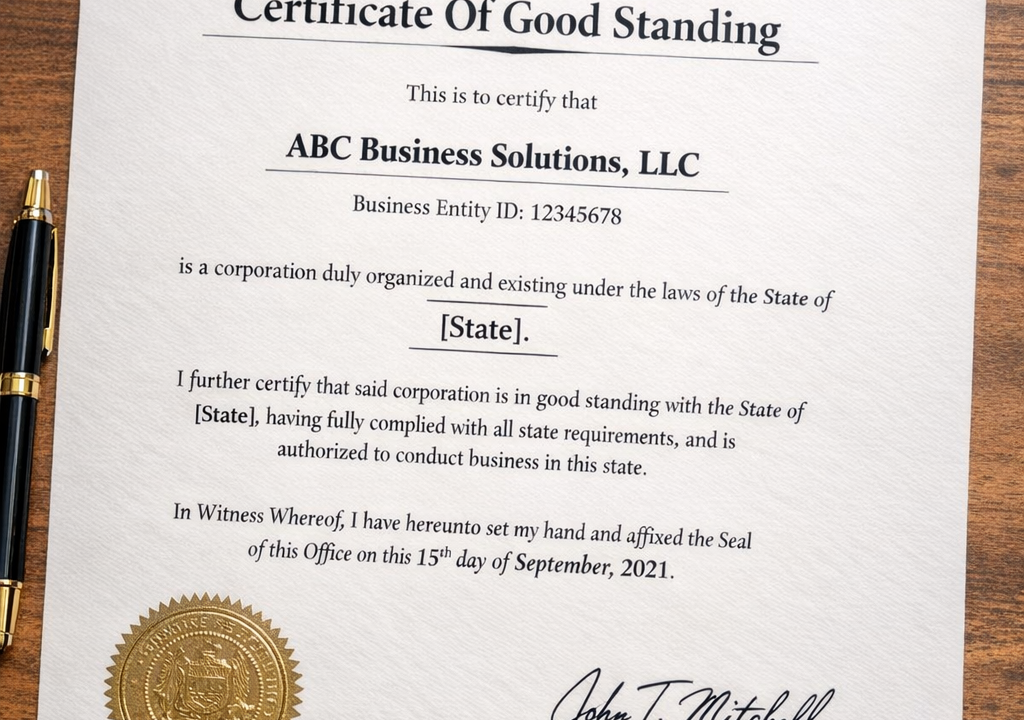
Quick Answer: A Certificate of Good Standing is an official state document proving your business is legally registered, has paid all required fees, and is authorized to conduct business. Get one from your Secretary of State’s office for $5-$50 (free in some states). Most states offer instant online access.
If you’ve ever tried to open a business bank account, apply for a loan, or expand your LLC into another state, you’ve probably been asked for a “Certificate of Good Standing.” This simple one-page document carries significant weight—without it, critical business transactions can stall or fall through entirely.
This guide explains exactly what a Certificate of Good Standing is, when you’ll need one, how much it costs in every state, and the step-by-step process to get yours quickly.
What Is a Certificate of Good Standing?
A Certificate of Good Standing is an official document issued by your state government (typically the Secretary of State’s office) that confirms your business:
- Is legally registered and recognized as a valid business entity
- Has filed all required documents (such as annual reports or statements of information)
- Has paid all state fees and taxes (including franchise taxes where applicable)
- Is authorized to conduct business in that state
- Has not been dissolved, suspended, or revoked
Think of it as a “clean bill of health” for your business—official proof that you’ve met all compliance requirements and can legally operate.
Different Names for the Same Document
Different states use different names for this document. They all mean the same thing:
| Document Name | States Using This Name |
| Certificate of Good Standing | Most states (default terminology) |
| Certificate of Existence | Texas, Arkansas, Kansas, Kentucky |
| Certificate of Status | New York, Delaware, Arizona |
| Certificate of Fact | Minnesota |
| Certificate of Subsistence | Pennsylvania |
| Certificate of Authorization | Some states (for foreign entities) |
Who Can Get a Certificate of Good Standing?
Business types that CAN get a certificate: LLCs, corporations (C-Corps and S-Corps), nonprofits, limited partnerships (LPs), limited liability partnerships (LLPs), and professional corporations (PCs).
Business types that CANNOT get a certificate: Sole proprietorships, general partnerships, and DBAs/trade names. These aren’t registered as separate legal entities with the state, so there’s no “standing” to certify.
The rule is simple: if your business type required state registration (like filing Articles of Organization), you can get a certificate. If it didn’t require registration, you can’t—but you also don’t need one.
8 Situations Where You’ll Need a Certificate of Good Standing
1. Opening a Business Bank Account
Most banks require proof that your LLC or corporation is legitimate and active before opening an account. This protects them from fraud and ensures you’re a real, compliant business.
2. Applying for Business Loans or Lines of Credit
Lenders view good standing status as a basic indicator of business reliability. If you can’t prove compliance, you’re a higher-risk borrower.
3. Foreign Qualification (Expanding to Another State)
If your LLC is formed in Delaware but you want to do business in California, California requires a Certificate of Good Standing from Delaware before registering you as a “foreign LLC.” This is one of the most common uses.
4. Signing Major Contracts or Leases
Large vendors, commercial landlords, and business partners often request proof of good standing before entering significant agreements—especially multi-year leases.
5. Renewing Business Licenses or Permits
Some local governments and licensing boards require proof of state-level compliance before renewing professional licenses or permits.
6. Accepting Credit Card Payments
Payment processors and merchant service providers may require a certificate when setting up your business account.
7. Selling Your Business or Bringing In Investors
Due diligence processes almost always include verification of good standing. Buyers and investors want proof the business they’re acquiring is compliant.
8. Bidding on Government Contracts
Federal, state, and local government contracts typically require proof that your business is properly registered and compliant.
Certificate of Good Standing Costs by State
Fees range from free to $175 depending on your state and certificate type. Here’s what you’ll pay in the 15 most common business formation states:
| State | Fee | Online? | Processing |
| California | $5 | Yes | Instant |
| Colorado | Free | Yes | Instant |
| Delaware | $50-$175 | Yes | Same day |
| Florida | $8.75 | Yes | Instant |
| Georgia | $10 | Yes | Instant |
| Illinois | $25 | Yes | 1-2 days |
| Massachusetts | Free | Yes | Instant |
| Nevada | $50 | Yes | Instant |
| New Jersey | $25 | Yes | 3-5 days |
| New York | $25 | Mail only | 1-2 weeks |
| North Carolina | $15 | Yes | Instant |
| Ohio | $5 | Yes | Instant |
| Pennsylvania | $40 | Yes | 3-5 days |
| Texas | $15 | Yes | Instant |
| Wyoming | $3 | Yes | Instant |
Note on Delaware: Delaware offers both a “short form” certificate ($50) that confirms status only, and a “long form” certificate ($175) that includes complete filing history. The short form is sufficient for most purposes.
How to Get a Certificate of Good Standing (4 Steps)
Step 1: Verify Your Business Is Actually in Good Standing
Before paying for a certificate, confirm your business is compliant. Most states offer a free business entity search on their Secretary of State website. Search for your business name and look for status labels like “Active,” “In Good Standing,” or “Current.”
If your status shows “Delinquent,” “Not in Good Standing,” “Forfeited,” or “Administratively Dissolved,” you’ll need to resolve those issues first before a certificate can be issued.
Step 2: Gather Your Business Information
You’ll typically need:
- Your exact legal business name (as registered with the state)
- State entity ID number or filing number
- Date of formation (required in some states)
- Payment method (credit card for online orders)
Step 3: Order Online or By Mail
Online (Recommended): Most states allow you to order and receive your certificate instantly or within 24-48 hours through their Secretary of State’s online portal. Search “[Your State] Secretary of State business services” to find the right page.
By Mail: Some states (notably New York) still require mail requests. Include your business name, entity ID, a written request for a Certificate of Good Standing, and a check for the fee. Allow 1-3 weeks for processing.
Step 4: Choose Standard or Expedited Processing
Need it urgently? Most states offer expedited processing for an additional $10-$75. This can reduce wait times from days to hours or even minutes.
How Long Is a Certificate Valid?
Certificates don’t technically “expire”—they’re accurate as of the date issued. However, whoever is requesting your certificate may require it to be dated within a specific timeframe:
- 30 days or less: Arkansas, Michigan, New Jersey, New Mexico, South Carolina, Vermont, Washington D.C., Wyoming
- 60 days or less: Arizona, Hawaii, Illinois (LLCs), Indiana, Missouri, Nebraska, Oklahoma, Oregon, Tennessee
- 90 days or less: Connecticut, Florida, Georgia, Idaho, Iowa, Kansas, Louisiana, Maine, Nevada, Ohio, South Dakota
- 6 months or less: California, Delaware, Montana, North Carolina
Pro Tip: Don’t order too far in advance. Wait until you’re close to needing the certificate to ensure it falls within the required timeframe.
What If You Can’t Get a Certificate of Good Standing?
If your state refuses to issue a certificate, your business has fallen out of compliance. Common reasons include:
- Missed annual report filings
- Unpaid state fees or franchise taxes
- Registered agent issues (resignation without replacement)
- Administrative dissolution by the state
To fix this: Contact your Secretary of State’s office to identify the specific issue. You’ll typically need to file any missing reports, pay outstanding fees plus late penalties, and possibly file a reinstatement application. Once resolved, you can order your certificate.
For a detailed guide on restoring compliance, see our article: What Happens If You Miss Your LLC Annual Report Deadline?
Frequently Asked Questions
Is a Certificate of Good Standing the same as a business license?
No. A Certificate of Good Standing confirms your business entity is registered and compliant at the state level. A business license is a permit (usually from a city or county) authorizing you to conduct a specific type of business. You may need both, but they’re different documents.
Can anyone request my company’s Certificate of Good Standing?
Yes. Certificates of Good Standing are public records. Anyone can request one for any registered business—they don’t need to be an owner or have authorization. This is how potential partners, lenders, and customers can verify your compliance status.
Can I get a certificate right after forming my LLC?
Yes, in most states you can request one immediately after your formation documents are processed and approved. Some states have a brief waiting period (a few days) before certificates become available.
Do I need certificates from every state I do business in?
If you’ve registered as a foreign entity in multiple states, you may need certificates from each state depending on who’s asking. A lender, for example, might want to see good standing in both your formation state and any states where you have significant operations.
What’s the difference between short form and long form certificates?
Some states (notably Delaware and New Jersey) offer both versions. A short form simply confirms the entity exists and is in good standing. A long form includes complete filing history—every document filed, name changes, and dates. Unless specifically asked for long form, short form is sufficient.
Get Your Certificate of Good Standing Today
A Certificate of Good Standing is one of the simplest yet most important business documents you’ll need. It’s proof that your business is legitimate, compliant, and authorized to operate—and without it, banks, lenders, and partners may refuse to work with you.
The good news: getting one is fast and inexpensive in most states. Visit your Secretary of State’s website, verify your business is in good standing, and order your certificate online. In most cases, you’ll have it within minutes for under $25.
If you discover your business isn’t in good standing, don’t wait—compliance issues only get more expensive and complicated over time.